
Arrangements of North-East Songs
Categories: Arrangements for choir, Choiry Endeavours
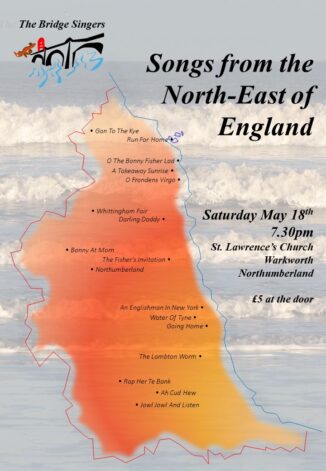
During the first half and a bit of 2024 The Bridge Singers have been learning and performing mainly repertoire from the north-east of England. Here are the programme notes from our concerts with clips and information about the North-East songs we’ve sung, and Cheryl has arranged.
The main concert for the year was in May 2024 at St. Lawrence’s Church, Warkworth.
O Frondens Virgo, Margaret Watchorn, solos: Rebekah, Julie. Inspired by a medieval song by Hildegard of Bingen (1098-1179), this setting was written especially for Rock Festival Choir of Alnwick in 2022 by Margaret, who is a good friend of our choir too, accompanying us in our Christmas concerts last year, and inspiring us at a recent singing day. In this very beautiful song, melodic fragments from the original plainsong, featuring soaring phrases, are set against a simple drone accompaniment or richer chords to evoke the radiance of the Virgin Mary and the promise of a new dawn. If you want to contact Margaret Watchorn…
The Fisher’s Invitation, Trad. Northumberland. The words (full title, “The Auld Fisher’s Invitation to his Friend in Newcastle”) for this song were written by Robert Roxby of Hartburn near Morpeth and Thomas Doubleday of Newcastle, for the 1832 “Fisher’s Garland”. This pair were regular fishermen around the rivers of Northumberland, particularly the Rede and Coquet. In this one, they refer to the pleasures of fishing in the Coquet near Weldon Bridge. They wrote lyrics to several fishing songs, generally using well-known tunes. The tune for this one is “Tak Your Auld Cloak About Ye” which could date from the 16th century, but definitely was published in the mid-18th century.
O The Bonny Fisher Lad, Trad. Northumberland – The fisher lasses of Bamburghshire very much prefer the handsome fishing lads to the soldiers and sailors, and sing about it in a very cheerful way.
Reading – The Duke Of Northumberland’s Ale, from “Rambles in Northumberland and the Scottish Borders” by William Andrew Chatto 1835
Darling Daddy, Gary Steward – a song based on the true story of a worker on the Alnwick Castle estate who signed up to serve in WW1 and wrote home regularly from a prisoner of war camp to his children. Gary wrote this song for us in 2018 as we prepared a concert of songs relating to WW1 and the centenary commemorations for the end of that war. We’ve sung a few of Gary’s songs in The Bridge Singers. You can read about them here.
Northumberland, Gary Steward – what a brilliant place it is to live, eh? Listen out for the gentle waves and the whistling wind as you settle in with your mates at the end of the day. Gary wrote this song many years ago and performed it with his band Piddler’s Pot. We’ve been singing this arrangement of it since we first formed and it’s one of our favourites.
Reading – The Harmony Of The Moon And Sea, from The Reckoning Of Time by The Venerable Bede (673-735), translated by Faith Wallis
Bonny At Morn, Trad. Northumberland – A farming song. The farmer parents regard their children as somewhat lazy, but they really are very good-looking! This is one of the most well-known Northumberland folk songs, and was first noted by John Bell in the early 19th century, although not published until 1882 in the “Northumbrian Minstrelsy”.
Gan To The Kye, Trad. Northumberland – More farmers, this time up in the border country, looking out at all times for battles and skirmishes with their northern neighbours. It starts out as a lyrical folk tune, but soon, with the threat from the north, becomes a bit more intimidating.
O Frondens Virgo, Margaret Watchorn – when a song is this sublime, and perhaps new to you, why not hear it again with a bit of familiarity under your listening belts!?
Interval
Rap Her Te Bank is a song from the Durham Coalfields. The first record of it being sung is in the early 1960s. The call “Rap ‘er Te Bank” went out from the miners at the bottom of the mineshaft. One of them would tap a signal on the lift cage and the winding man on the surface (the bank) would bring the cage up at the end of the shift.
Ah Cud Hew, Ed Pickford, solos: Julie, Penny, Chris and Peter in verse 3 and Rebekah, Alison, Jamie and Connor in verse 5. This song is about the perils of breathing in coaldust and the subsequent illness, pneumoconiosis, or simply ‘the dust’, which resulted in many miners being forced to stop working before their time, and indeed, many untimely deaths of coal miners.
Jowl, Jowl and Listen is another song from the Durham Coalfields, again first noted in the early 1960s, but could be older. The song has a cheery-sounding tune, but the lyrics are really a warning of the dangers of rock falls and collapse. There’s a lot of use of local pit language – we’ve put the lyrics with a glossary on the back page!
Reading: The apprehension of danger… using extracts from “Rambles in Northumberland and the Scottish Borders” by William Andrew Chatto (1835)
Englishman In New York, Sting. It’s a song from his 1987 album, …Nothing Like The Sun, and was written about Quentin Crisp who Sting met after he had recently moved to New York from the UK. Quentin Crisp appears on the video for the song, and the original version also features the soprano saxophone playing of Branford Marsalis – his role in our version is taken by the sopranos! Sting himself was born in Wallsend in 1951, and one fact we like, is that for a time after leaving school and college he was a primary school teacher in Cramlington. He then went on to be in The Police, make lots of solo albums, and be an all-round musical superstar, of course.
Days, Ray Davies. This is a song by The Kinks, who are from London, we realise, and therefore this song has nothing to do with the north-east. However, we love it, and did learn that when The Kinks were on their North American Tour in 1972, their support band was Lindisfarne, on their first overseas tour…so we feel that gives us permission to perform it today! Ray Davies wrote this song in 1968 in response to his sister emigrating to Australia.
Run For Home, Alan Hull. This song was a top ten hit for Lindisfarne in 1978, and featured on their album “Back and Fourth”. Lindisfarne was originally a five-piece band who formed in 1968 in Newcastle. They’ve split up and re-formed several times since then, brought in some new members, had several hits including Fog On The Tyne and Meet Me On The Corner, and are still going today. This really is one of their most popular songs.
Reading – Harry Miller’s Run (excerpt) from “half a creature from the sea – A Life in Stories” by David Almond (2014)
The Lambton Worm, Jack Leumane. Recorder: Alison. The legend of the Lambton Worm is a traditional tale from the Wearside area. This jovial song was composed in 1867 as part of a pantomime for the Tyne Theatre and Opera House in Newcastle. Jack Leumane (real name Matthew Catcheside) was an actor and singer, possibly born in Sunderland, who performed in all sorts of plays and comic opera productions around Britain, then went to Australia with a touring company in the 1880s and ended up staying there. He died in South Australia in 1928.
The Water Of Tyne, Trad. Tyneside. One of the most famous songs of the north-east, this is another first noted by John Bell in the early 19th century, but could well be from much earlier. It has a lyrical melody, and a plaintive sentiment.
Whittingham Fair, Trad. Northumberland. It’s one of a series of English folksongs (including Scarborough Fair, The Elfin Knight, Rosemary Lane) which is a dialogue between two potential lovers who set each other impossible tasks before they will consider partnering up. We’re not very optimistic that this particular relationship will last, nor even get started!
Later on in the year, we did master our third new popular song from the north-east, and performed it a few times to great acclaim!
Going Home by Mark Knopfler. it’s the theme from the movie Local Hero. During the movie, this theme returns many times, reflecting a variety of different moods. We’re going for calm and reflective as we are not a guitar-and-drum centred rock band. We hope one day to do a joint effort with our pals The Claptones who also currently have it in their repertoire, and do indeed have guitars and a drum kit (also three of our members, who’ll have to decide where their loyalties lie, come that glorious day!) [Programme note from Feltonbury, June 22nd 2024]
Another postponement from May, due to the pressures of insufficient time to learn and the like, was the world premiere of my own A Takeaway Sunrise with lyrics by Ian McMillan. We gave the world premiere on September 30th 2024 at the Rennington Music Festival. You can read more about that song here!
All arrangements for these songs are available from Cheryl. Contact Cheryl


No comments yet.