
Songs For May Day, The Bridge Singers
Categories: Choiry Endeavours
It was a celebration of songs inspired by May Day itself and the beginning of May in general – the onset of summery times, the sunrise, love (the hope of it, the actuality of it, the loss of it), workers’ rights, some May festivals, both folk and religious – and also a few stray songs that we just happen to like at the moment!
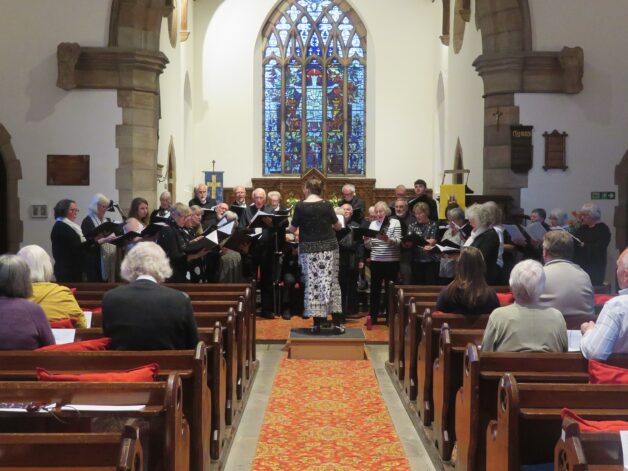
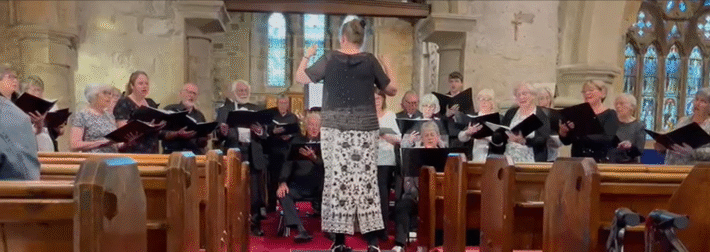
What follows are the programme notes, some clips and some photos of the two concerts in Wooler on April 25th and Felton on May 12th 2025:
Somebody To Love, Freddie Mercury – This is the first of our three love songs, but there’s no love yet, only the craving of it! At least not in the lyrics of this Queen song from 1976. It was on their album A Day At The Races, and also the Greatest Hits album in 1981. We love it though! There’s more than a hint of gospel choir influencing both Queen’s original recording and our version of it. Each section of the choir gets equal bits of the tune – it’s very equitable!
…and some cheering feedback too: “The opening of the concert was so remarkable. I was astonished by the first note. I couldn’t believe that you were going to sing this song and as it went on I was just about in tears. Well done!”
And So It Goes, Billy Joel – We’ve found love in this hit from Billy Joel’s 1986 album Storm Front. It’s such a gentle, warm song. We first did the learning of it at the beginning of 2021 when we were having to have our rehearsals via Zoom. We continued to sing it during the rest of that year, and it’s a proper treat to bring it back out of the library this year.
Teo Torriatte (Let Us Cling Together), Brian May – It’s full of love, and a long-standing love, we think! The song’s also from Queen’s 1976 album A Day At The Races. They released it as a single in 1977, but only in Japan, as a thank-you gift to their Japanese fans who greeted them on their 1975 tour there with huge amounts of warmth and enthusiasm. The romantic and very beautiful song has two choruses in Japanese and two in English – a rough translation of the Japanese. Queen only ever performed the song live 17 times while Freddie Mercury was alive and only ever in Japan. The song was also used as part of the opening ceremony of the Tokyo Olympics in 2021.
A Man’s A Man For A’ That, Trad. Scotland, Robert Burns – In this 1795 poem, Burns is exercised by a lack of egalitarianism in society during his lifetime. Poorer people did not have the right to vote and he addresses this social injustice. This song was performed by Sheena Wellington at the opening of the Scottish Parliament in 1999, and is one of our favourites of Burns’ songs. Do join us in the last verse – there are five altogether, so you’ll know the tune by then!
Four Pence A Day, Cheryl Camm, Trad. N.E.England – It’s a sad tale from the point of view of a 19th century lead miner (just a boy) in Upper Weardale. You may have visited the museum at Killhope Lead Mine. The technique for finding the seams of lead then, involved building a dam at the top of a hill, then letting the water out all of a sudden so that the topsoil was washed away, exposing the lead beneath. That’s where they’d start on their tunnels. This rush of water was called a “hush”. You’ll hear us simulate that at the beginning of the song. Our soloist in verse 1 is Richard Styring.
Bread And Roses, Caroline Kohlsaat, James Oppenheim – This poem was first published in 1911 and was inspired by the Women’s Suffrage movement in the USA. The song itself appeared in 1917, and was then revived in the 1950s and 1960s, with a few different recordings. We like the version from the 2014 film Pride. The bread is food for the body, the roses are food for the mind.
Omnes de Saba, Ave Maria, Ascendit Deus, Jacob Handl – Omnes de Saba is an Epiphany anthem, so not relevant to our theme at all, but the other two are, what with May being the month both of Mary and Ascension Day … and it’s nice to have three in a set, eh?! Jacob Handl was around between 1550 and 1591, was born in the region of Carniola in Slovenia and wrote over 500 works, both sacred and secular. Our three songs or anthems are all a bit lively, (although the Ave Maria starts off in a gentle manner, including a solo by Rebekah Hoskins), and all have a mixture of imitative textures (you can hear one part then another sing the same musical ideas, copying and weaving in and out of each other) and hymn-like textures where everyone sings the same rhythms at the same time. It’s all very dramatic anyway.
Padstow May Song, Trad. Cornwall – This jovial and spirited song is part of the May Day Obby Oss festivities in Padstow, Cornwall when parades with singing and instrument playing meander through the town from late night on April 30th then well into May 1st. There’s a solemn bit in the middle of the song which seemingly makes no sense, when apparently the parades sometimes stop briefly before heading off again in raucous fashion!
Hinemoa, Trad. New Zealand – We’re back to our love songs, with this song of the beautiful Maori wahine (woman), Hinemoa, who will stop at nothing to reach her love. There are versions of this song that are soft and sweet, and others that are more spirited and feisty. I wonder which we’ll go for tonight?!
Hal-An-Tow, Trad. Cornwall – Another vigorous Cornish song, this time from Helston, which has a celebration called Furry Day on May 8th with processions…not quite May Day, but then it isn’t quite May Day today, either!
How Beautiful Are The Feet, Their Sound Is Gone Out, He Shall Feed His Flock, G.F.Handel – We’ll sing these three movements from The Messiah unaccompanied…or rather we’ll accompany ourselves with ooh-ing and doo-ing. The outer two movements are actually solos in the original, and both have flowing and rather beautiful melodies. Their Sound Is Gone Out is an exuberant fanfare. Handel (1685-1759) wrote The Messiah in London, where he lived from 1712 until he died, but the first performance was in Dublin in 1742. It’s an oratorio (a religious opera with no acting!) with a libretto assembled by Charles Jennens from the bible.
I Am A Rock, April Come She Will, 59th Street Bridge Song, Paul Simon – The first is from 1965 and was on Simon and Garfunkel’s 1966 album Sounds Of Silence. It’s a hot-headed sort-of song about someone with no emotional connections to anyone. The second is from 1964 and also on Sounds Of Silence. There’s an emotional connection now, but the subject of the writer’s affections changes her moods and attentions as the months (including May!) dance on by. The third is from the 1966 album, Parsley, Sage, Rosemary and Thyme and takes us on a stroll along the bridge that links Queens and Manhattan (apparently there are cobbled streets and historic brass lamp-posts, which are referred to in the song!)
Knit Me Together, Cheryl Camm, Psalm 139 – This song was composed in memory of our lovely alto Carol Evans, who died in 2024, in response to a commission from her husband Richard who is also in the choir. Four of us gave the world premiere in December, and now those original soloists are joined by the whole choir. Richard selected the lyrics from the psalm and we all remember cheerily Carol’s adventurous knitting projects! The music knits itself elaborately together too. The quartet is Rebekah, Cheryl, Jamie and Connor.
Now Is The Month Of Maying, Thomas Morley. Fair Phyllis, John Farmer – These are both English madrigals from the very end of the 16th century. One has lots of fa-la-la-ing, one has lots of up-and-down-ing, they’re both exceedingly lively, they’re both full of cheery interchange between the melodies in each part, they’re both slightly bawdy in a 16th century pastoral sort-of way, and one of them is actually a May Day song, perhaps!
Ubi Caritas, Maurice Duruflé – This rather beautiful and reflective motet was composed in 1960 and first performed in Paris in 1961. The melodies are based on a Gregorian chant (the sacred chants European monks developed in the 9th and 10th centuries for their devotions.) The text is often used on Maundy Thursday. Maurice Duruflé was an organist, composer and professor of harmony and lived from 1902 to 1986 in France.
Hail Smiling Morn, Reginald Spofforth – It’s joyous, that’s what! It includes these words: “Hail smiling morn that tips the hills with gold, Whose rosy fingers ope the gates of day.” I mean, really…what’s not to love about that! Reginald Spofforth (1769-1827) was born in Nottinghamshire, and worked in London as an organist, teacher and composer of popular, cheery songs. He used to get up very early and work very hard! Cheryl heard this song on the radio at Christmas and decided there and then that it was for us. Some (most) of us are going to attempt this one from memory!
One last bit of feedback (we did get quite a lot as it happens – almost all completely positive!): “I met a lady in the shop today who had come to the concert on Saturday. She was extremely impressed with the choir and what you have produced with us… she had sat with a musician friend and they couldn’t believe the versatility and prowess of the singing (her words not mine!)”


No comments yet.